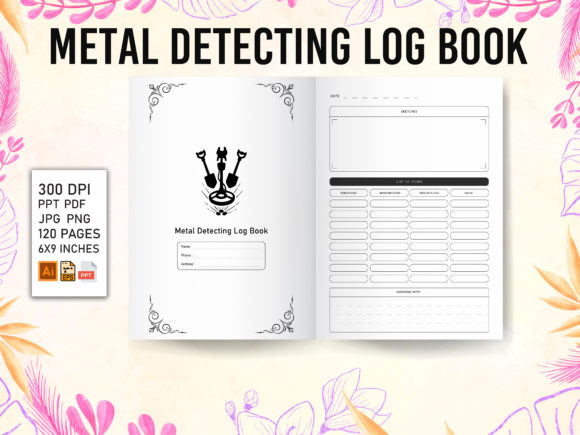
Optimizing Your Publishing Portfolio with a Metal Detecting Log Book KDP Interior
The low-content publishing landscape on Amazon has evolved significantly, moving away from generic notebooks toward highly specialized tools that serve specific communities. Among these emerging opportunities, the metal detecting niche stands out as a prime example of functional utility meeting passionate hobbyist demand. Utilizing a dedicated Metal Detecting Log Book - KDP Interior allows publishers to tap into a market where users are not merely seeking blank pages, but structured data collection tools designed for field use. This shift requires a deeper understanding of both the technical specifications of print-on-demand interiors and the practical needs of detectorists who rely on accurate record-keeping to improve their success rates over time.
Functional Anatomy of a High-Utility Detectorist Journal
To create a product that genuinely serves the metal detecting community, one must understand what information is critical during a hunt. A superior interior goes beyond simple lines; it acts as a field database. When evaluating or designing a Metal Detecting Log Book - KDP Interior, the inclusion of specific tracking fields determines the product's value proposition. Experienced detectorists need to log environmental and technical variables that influence signal accuracy and recovery depth.
- GPS and Location Data: Precise coordinates are essential for returning to productive sites or avoiding previously hunted areas. Fields for latitude, longitude, and site descriptions (e.g., "old park bench," "river bend") provide context that memory alone cannot sustain.
- Equipment Settings: Detectors have complex discrimination patterns, sensitivity levels, and ground balance settings. Logging these parameters alongside find results helps users correlate specific machine configurations with successful recoveries in different soil mineralizations.
- Target Identification Metrics: Spaces for recording VDI (Visual Discrimination Indicator) numbers, tone responses, and estimated depths allow hunters to refine their ability to distinguish between trash and treasure based on historical data.
- Environmental Conditions: Soil type, moisture levels, and weather conditions significantly affect conductivity. A well-designed interior includes checkboxes or short-entry fields for these variables without consuming excessive writing space.
- Finds Categorization: Dedicated sections for classifying items (coins, jewelry, relics, war memorabilia) help users track the profitability and historical significance of their outings.
This level of granularity transforms a simple notebook into an analytical tool. Publishers who source or create interiors with these specific elements differentiate their products from generic competitors, directly addressing the user intent behind searches for specialized logging books.
Technical Versatility Through Multi-Format Asset Delivery
One of the significant advantages of modern digital asset ecosystems is the flexibility provided by multi-format delivery. When acquiring a Metal Detecting Log Book - KDP Interior, having access to AI, PPT, EPS, PDF, PNG, and JPG files offers distinct operational benefits for publishers at various stages of business development. Understanding when and how to utilize each format ensures workflow efficiency and product quality.
Vector Formats for Customization and Scalability
Adobe Illustrator (AI) and Encapsulated PostScript (EPS) files represent the gold standard for interior customization. Because these are vector-based formats, they allow for infinite scaling without pixelation, ensuring crisp lines regardless of trim size adjustments. More importantly, they enable publishers to modify the layout. If market research suggests adding a "coil used" field or removing an unnecessary section, vector files make this editing seamless. This adaptability is crucial for creating unique variations of a base template, preventing market saturation and allowing for A/B testing of different interior layouts.
Raster and Presentation Formats for Marketing and Proofing
PNG and JPG files serve a different but equally vital purpose: marketing. While you cannot upload a raster image as the primary interior file for a text-heavy logbook due to potential blurriness, these high-resolution images are perfect for creating Amazon listing mockups. Showing potential buyers exactly what the interior pages look like increases conversion rates by reducing purchase anxiety. PowerPoint (PPT) files offer a middle ground, often serving as accessible editing platforms for creators who do not own Adobe Creative Cloud software, democratizing the ability to make minor text or layout adjustments.
Print-Ready PDF for Immediate Deployment
The pre-formatted 100-page PDF is the workhorse of the package. For publishers focused on speed-to-market, this file eliminates the risk of formatting errors. It has typically been tested against Amazon KDP’s strict margin and bleed requirements. Using a verified PDF reduces the rejection rate during the upload process and ensures that the final printed product matches the digital proof exactly. This reliability is particularly valuable when scaling a publishing business across multiple niches simultaneously.
Strategic Market Positioning in Specialized Hobbies
Metal detecting is not a monolithic hobby; it comprises several sub-niches, each with unique logging requirements. Success in selling a Metal Detecting Log Book - KDP Interior often depends on aligning the product with these specific segments. General-purpose logbooks face higher competition, whereas targeted interiors can dominate smaller search categories.
Beach and Water Hunting: Saltwater environments require corrosion-resistant equipment and different search techniques. Interiors tailored for beach hunters might include tide charts, sand condition notes, and saltwater vs. freshwater mode tracking. These users also tend to hunt during specific tidal windows, making time-stamping more critical than in land-based hunting.
Relic and Historical Site Hunting: Hunters focused on Civil War sites, colonial homesteads, or abandoned settlements prioritize historical context over target ID numbers. Logbooks for this demographic benefit from sections dedicated to historical research notes, map overlays, and artifact preservation status. The value here lies in connecting the physical find to its historical narrative.
Coin Shooting and Park Hunting: This is often the entry point for new hobbyists. Logbooks targeting this group should be simpler, focusing on date/mint mark recording, coin grading estimates, and total value tallies. Educational prompts or reference charts included in the interior can add perceived value for beginners still learning to interpret signals.
By leveraging editable source files, publishers can create niche-specific variants from a single master template. This strategy maximizes the return on investment for the initial asset acquisition while building a comprehensive catalog that addresses the full spectrum of the metal detecting community.
Quality Assurance and Platform Compliance
Even the most beautifully designed interior will fail if it does not meet Amazon KDP’s technical standards. The mention of "fully tested" interiors is significant because printing tolerances vary. Margins that appear adequate on screen may be trimmed during binding, rendering edge content unusable. Gutter margins must account for page count; a 100-page book requires different gutter spacing than a 200-page volume to ensure writability near the spine.
Publishers should always verify downloaded PDFs against current KDP specifications before uploading. Key checkpoints include:
- Bleed Verification: Ensuring any background elements or border graphics extend 0.125 inches beyond the trim line to prevent white edges after cutting.
- Safe Zone Adherence: Confirming all text and functional writing areas remain within the safe zone, accounting for binding shifts.
- Resolution Standards: Validating that any embedded graphics maintain at least 300 DPI at final print size to avoid aliasing or blur.
- Color Profile Accuracy: Ensuring interiors are set to grayscale or CMYK as appropriate, preventing unexpected color shifts in black-and-white printing options.
Utilizing pre-tested templates mitigates these risks, but responsible publishers treat every download as a starting point rather than a guaranteed endpoint. Running a digital proof through KDP’s previewer tool remains an essential step in maintaining quality standards and protecting brand reputation.
Expanding Revenue Streams Through Design Ecosystems
The intersection of KDP interiors and merchandise design represents an underutilized growth opportunity. Many metal detecting enthusiasts express their passion through apparel as well as literature. Publishers who follow creators offering both KDP interiors and T-shirt designs can build cohesive brands across multiple platforms. The visual language that appeals to detectorists in a logbook—vintage aesthetics, technical schematics, topographic motifs—often translates effectively to wearable merchandise.
This cross-pollination extends beyond mere aesthetics. Understanding the terminology and culture required to design a useful logbook inherently provides the knowledge needed to create resonant T-shirt designs. Phrases, inside jokes, and technical references that validate a user’s identity in a journal will likely perform well on apparel. By staying engaged with designers who operate across both mediums, publishers gain continuous exposure to trending sub-niches and emerging visual styles within the metal detecting community.
Furthermore, the skills developed in customizing KDP interiors using AI and EPS files transfer directly to merchandise creation. Mastery of vector editing software enables publishers to adapt interior graphics for shirt designs or vice versa, creating a unified product ecosystem. This diversification reduces dependency on any single revenue stream while deepening engagement with the target audience across multiple touchpoints in their hobby journey.
Evaluating Long-Term Viability in Functional Publishing
Sustainable success in low-content publishing requires viewing products as evergreen assets rather than trendy novelties. Metal detecting has demonstrated consistent growth over decades, driven by technological advances in detector sensitivity and increased interest in local history and outdoor recreation. This stability makes it an attractive niche for long-term portfolio development.
However, longevity requires adaptation. As detector technology evolves, so do logging needs. Modern machines with GPS integration and wireless connectivity may reduce the need for manual coordinate logging while increasing demand for battery life tracking or firmware version notes. Publishers who monitor hobbyist forums, YouTube channels, and manufacturer updates can identify these shifting requirements early. Having access to editable source files becomes strategically important in this context, enabling rapid iteration of interiors to match evolving user behaviors.
Customer feedback loops also play a critical role in sustaining relevance. Reviews mentioning missing fields or layout frustrations provide direct market research for future editions. Treating each published logbook as a living product subject to refinement based on real-world usage data builds customer loyalty and improves organic ranking through enhanced satisfaction metrics. In a niche where word-of-mouth recommendations carry significant weight, delivering genuine utility through thoughtful interior design creates compounding advantages over time.