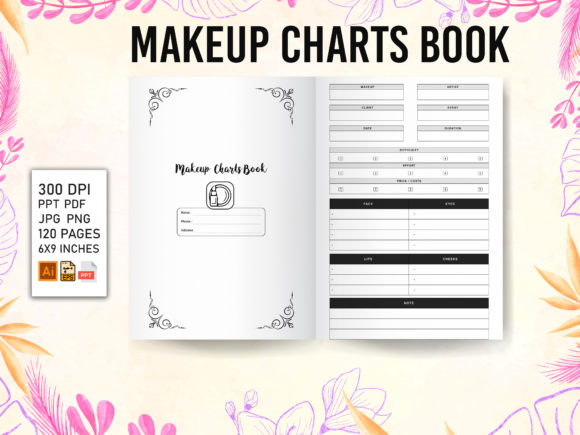
Evaluating the Makeup Charts Book KDP Interior for Low-Content Publishing
The low-content and medium-content publishing market on Amazon has matured significantly, moving beyond simple lined journals into specialized utility books. For publishers targeting the beauty and cosmetology niche, the Makeup Charts Book KDP Interior represents a functional asset designed to bridge the gap between generic notebooks and professional reference guides. This resource provides pre-formatted layouts specifically structured for recording cosmetic formulations, color theory applications, and client consultation notes. Rather than creating these technical diagrams from scratch, publishers can leverage this interior to produce high-utility books that serve makeup artists, estheticians, and beauty students.
The primary value proposition of this interior lies in its specificity. General planners are saturated, but vocational tools remain in demand. A makeup chart book serves as a practical workbook where professionals can document face shapes, eye placements, contouring techniques, and product mixing ratios. By utilizing a pre-designed Makeup Charts Book KDP Interior, creators can bypass the steep learning curve associated with technical illustration and focus instead on cover design, keyword research, and marketing strategy. This shift allows for faster iteration and testing within a niche that values precision and visual clarity over decorative elements.
Technical Specifications and File Versatility
A critical factor in evaluating any KDP template is the flexibility of the source files. This package distinguishes itself by offering a comprehensive suite of formats rather than a single static PDF. The inclusion of AI (Adobe Illustrator), EPS, PPT (PowerPoint), PDF, PNG, and JPG files addresses various workflow preferences and software access levels.
- AI and EPS Files: These vector-based formats are essential for professional customization. They allow users to modify line weights, adjust dimensions, and alter text without pixelation. For publishers who wish to create a unique brand identity or adapt the charts for different trim sizes, vector access is non-negotiable.
- PowerPoint (PPT) Files: This is a significant accessibility feature. Many KDP creators do not own Adobe Creative Cloud subscriptions. Providing an editable PPT version democratizes the asset, allowing users to rearrange pages, add branding, or modify chart labels using standard office software.
- Print-Ready PDF: The package includes a 100-page PDF formatted specifically for Amazon KDP upload. This file serves as the baseline product, tested for margin compliance and bleed requirements. It enables immediate listing for those who do not require customization.
- PNG and JPG Assets: While less useful for the book interior itself, these raster images support marketing efforts. They can be utilized for A+ Content, social media promotion, or mockups to showcase the book’s internal layout to potential buyers.
This multi-format approach mitigates the risk of obsolescence. If Amazon updates its printing specifications or if a publisher wants to expand the series to a larger trim size, the source files provide the necessary foundation for adaptation without requiring a complete redesign.
Practical Application and Niche Relevance
Understanding the end-user is vital for successful KDP publishing. The Makeup Charts Book KDP Interior targets a demographic that requires functional documentation tools. Primary users include freelance makeup artists building portfolios, cosmetology students practicing anatomy and color theory, and beauty influencers developing educational content. Unlike a diary, this book solves a specific problem: the need to visualize and record technical application data consistently.
In real-world use, the effectiveness of this interior depends on the accuracy of the anatomical outlines and the utility of the designated note spaces. High-quality makeup charts must account for diverse face shapes and features. Publishers should evaluate the included templates to ensure they represent a range of demographics, as inclusivity is increasingly important in the beauty industry. Furthermore, the balance between guided structure and blank space determines usability. Professionals often need room for swatching physical products alongside printed diagrams; a layout that is too dense may discourage active use.
From a business perspective, this niche offers better longevity than trend-based journals. Beauty education is evergreen, and professionals continually seek tools to refine their craft. However, success requires positioning the book correctly. It should be marketed not merely as a "notebook" but as a "professional development tool" or "client consultation log." The pre-made interior facilitates this positioning by providing the structural credibility that a blank notebook lacks.
Quality Assurance and Platform Compliance
One of the most common pitfalls in KDP publishing is rejection due to formatting errors. Margins, bleed zones, and resolution standards are strict. The assertion that this Makeup Charts Book KDP Interior is "fully tested" suggests that the 100-page PDF has been validated against current Amazon guidelines. This reduces the friction between acquisition and publication.
However, prudent publishers should always perform independent verification. Printing technologies and platform requirements evolve. Before uploading, it is advisable to download the latest KDP previewer tool and run the provided PDF through it. Check specifically for:
- Margin Safety: Ensure no chart elements fall within the non-printable gutter area, especially on double-page spreads.
- Resolution Clarity: Verify that fine lines in the face charts remain crisp at 100% zoom. Blurry lines render a technical book useless.
- Paper Opacity Considerations: Standard KDP paper (55# or 60#) has some transparency. If the charts involve heavy ink coverage or double-sided printing, ensure the design accounts for potential bleed-through, or recommend premium paper options in the book description.
The availability of high-resolution source files acts as an insurance policy. If the pre-made PDF fails validation or if you identify a layout improvement, the AI or PPT files allow for immediate correction. This reliability is crucial for maintaining a professional publishing portfolio and avoiding negative reviews related to print quality.
Strategic Customization and Differentiation
While the ready-to-upload PDF offers speed, long-term sales growth typically requires differentiation. Using the exact same interior as other sellers leads to commoditization. The editable files included in this package are the key to creating a defensible product. Publishers should consider several customization strategies to enhance value:
Branding Integration: Use the AI or PPT files to add a consistent header, footer, or logo to each page. This transforms a generic template into a branded series, encouraging repeat purchases and customer loyalty.
Niche Specialization: Modify the base charts to target sub-niches. For example, adapt the general face charts for special effects (SFX) makeup, bridal artistry, or permanent cosmetics. Adding specific terminology or measurement guides relevant to these sub-fields increases perceived expertise and relevance.
Supplementary Content: Combine the charts with original educational text. Adding introductory chapters on color theory, hygiene protocols, or business management elevates the book from a low-content item to a medium-content resource. This hybrid approach often commands higher price points and attracts a more serious audience.
Cover Design Alignment: The interior sets expectations that the cover must fulfill. Since the download includes PNG/JPG assets, use them to create accurate interior previews for your cover and A+ Content. Misalignment between cover promise and interior reality is a primary driver of returns and negative feedback.
Assessing Value and Workflow Fit
The Makeup Charts Book KDP Interior is best suited for publishers who view templates as starting points rather than final products. Its strength lies in the combination of immediate usability and deep customizability. For beginners, the tested PDF lowers the barrier to entry. For experienced publishers, the vector files save dozens of hours of drafting time while enabling unique product development.
Potential limitations should be acknowledged. As a digital asset, it cannot guarantee sales; market research and keyword optimization remain the publisher's responsibility. Additionally, while the PPT file increases accessibility, PowerPoint is not a professional layout tool. Complex typographic adjustments or precise grid alignments may be frustrating or limited compared to Illustrator or InDesign. Users relying solely on PPT should manage their expectations regarding design refinement.
Ultimately, this resource fits the workflow of entrepreneurs seeking to scale their KDP business efficiently. It removes the technical bottleneck of creating anatomical diagrams, allowing focus to shift toward market analysis and audience engagement. When used strategically—with attention to customization, quality verification, and niche targeting—the Makeup Charts Book KDP Interior serves as a solid foundation for building a sustainable catalog in the competitive beauty education sector. Success will depend less on the asset itself and more on how effectively the publisher integrates it into a broader, value-driven publishing strategy.